
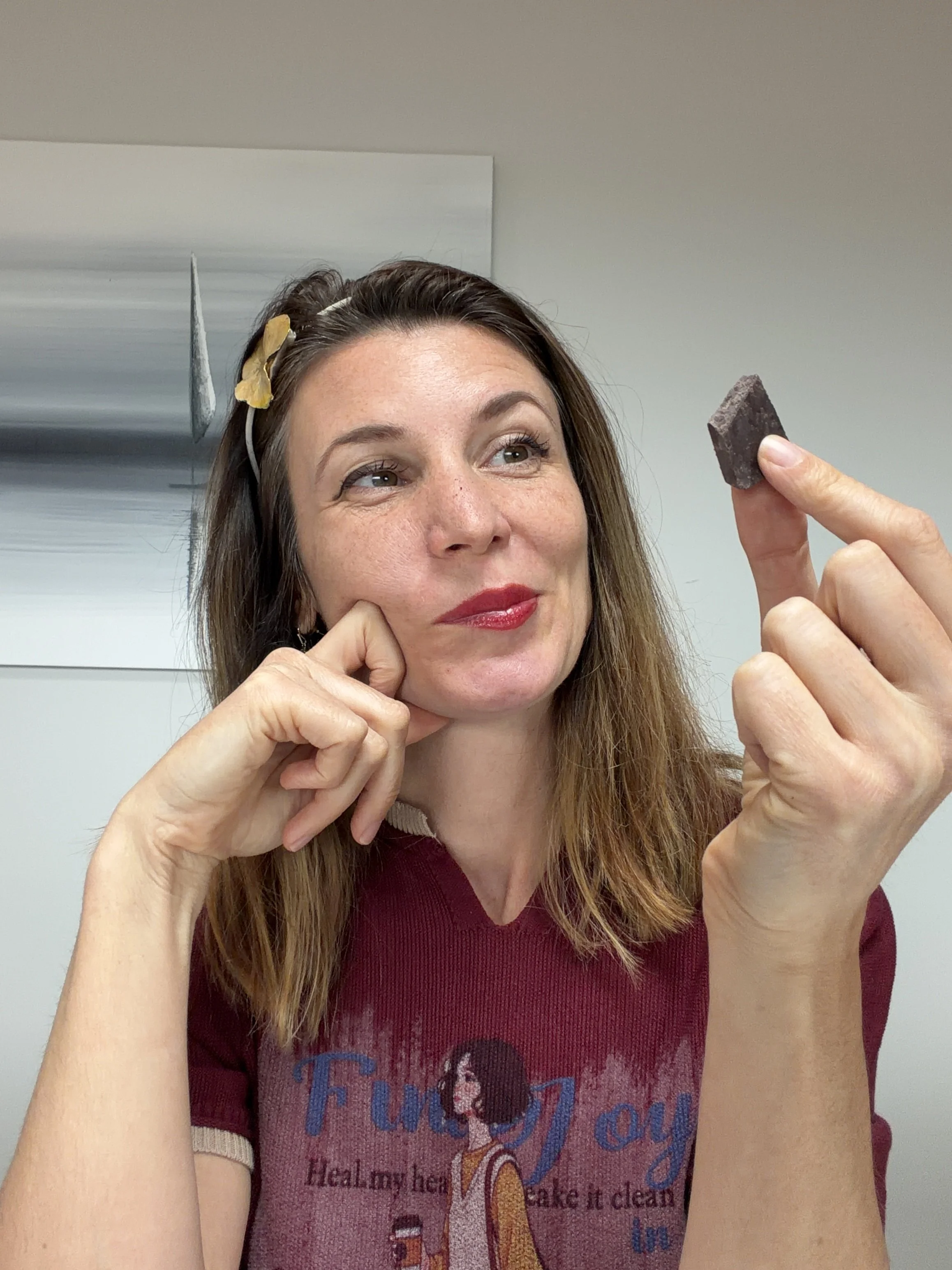
Me, asking a square of chocolate to show me its peer-reviewed studies!
If you're trying to conceive or going through IVF, you've probably seen it: “Eat dark chocolate, it's great for fertility”. I wanted to know if that's actually true.
I'm currently enrolled in a Harvard nutrition program, and one of the biggest things we're learning is how to read studies properly, not just headlines. So last night I spent four hours digging into this one question. Here's what I found, including the questions I kept asking myself along the way.
What you've probably heard
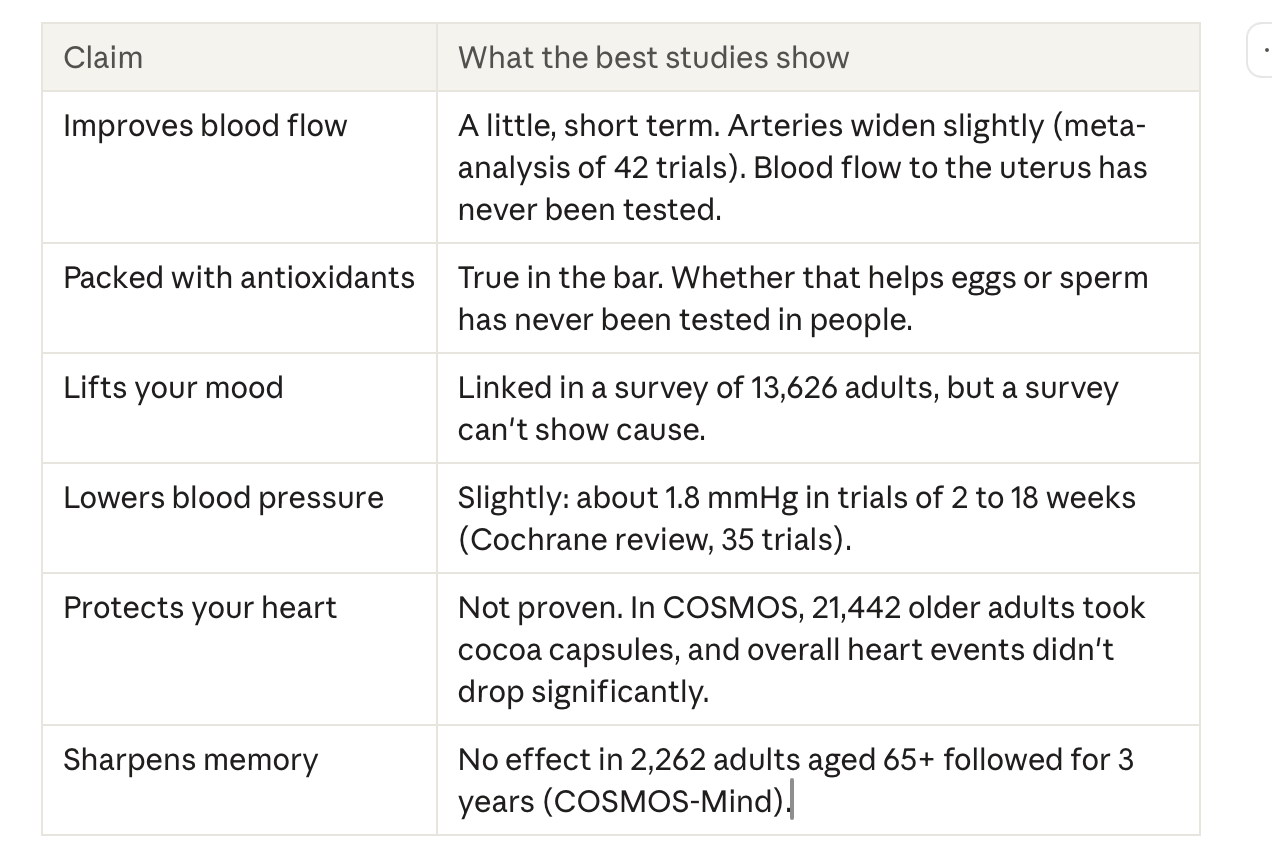
Dark chocolate gets a lot of credit. It's supposed to:
Improve blood flow
Be packed with antioxidants
Lift your mood
Lower blood pressure
Protect your heart and sharpen your memory
So I looked for the best studies behind each claim, meaning large trials in humans and reviews that combine many trials, not lab or animal studies.
So, does it help fertility or IVF?
Here's what surprised me: not one human study has tested chocolate on fertility or IVF outcomes. Not one. The fertility claims rest on theories (blood flow, antioxidants, insulin) and on studies done in rats and rabbits.
Wait, so most of these studies aren't even done in humans? For fertility, that's right. Even the closest thing, a trial in pregnant women at higher risk of preeclampsia, compared high- and low-flavanol dark chocolate and found no difference in pregnancy outcomes.
And here's the other twist. The big human trials, like COSMOS, didn't use chocolate at all. They used cocoa extract capsules. Getting that same daily dose (500 mg of flavanols) from dark chocolate would take about 600 calories a day.
Even single supplements tested in rigorous trials have disappointed. In a JAMA trial of 2,370 couples, folic acid and zinc for men didn't improve sperm or live birth rates. And in the MOXI trial of 171 couples, an antioxidant blend for men didn't improve sperm.
Cocoa vs. dark chocolate: not the same thing
Is it true that most of the flavanols get lost? Mostly, yes. Cocoa is the bean, and that's where the flavanols are. Dark chocolate is cocoa plus cocoa butter and sugar. And every step from bean to bar strips flavanols out:
Fermenting the beans lowers them, and the longer the fermentation, the bigger the drop
Roasting at high heat removed up to 88% of the main flavanol in one lab study
"Dutch" processing (alkalizing) causes the biggest losses: about 60% on average, and up to 98% in one study. It's mostly used for cocoa powder, not bars.
So if you buy it, go for 70% cocoa or more. Milk chocolate has far less.
One more catch: in a 2022 Consumer Reports test, 23 of 28 dark chocolate bars had lead or cadmium above California's daily limits in a single ounce. Cadmium is linked to reproductive harm and birth defects, and lead can affect a baby's brain development. A Johns Hopkins toxicologist told NPR that eating chocolate in moderation isn't a worry, and that getting enough calcium and iron reduces how much of these metals your body absorbs.
Why isn't there better research?
This was my next question. If chocolate is talked about this much, why hasn't anyone tested it properly? A few reasons:
Money. Large human trials cost millions, and no one can patent a food. So few companies will fund them.
Real life is messy. People don't eat the same way for months, and they misremember what they ate.
Fertility has many moving parts. Age, sperm, the clinic, the protocol. Pinning a result on one food is really hard.
So does that mean dark chocolate isn't healthy? No. Not proven doesn't mean not healthy. It means we don't know yet.
What we do know: whole diets
While single foods are hard to study, whole eating patterns have been studied in large groups of women. Two Harvard studies stood out:
The Nurses' Health Study II: 18,555 women followed for 8 years. A "fertility diet" rich in plant protein, full-fat dairy and healthy fats was linked to a 66% lower risk of ovulation-related infertility. Trans fats, highly refined carbs and lots of sugary sodas were linked to higher risk, and a daily multivitamin to lower risk.
The EARTH study at a fertility clinic: 357 women going through 608 IVF cycles. A "profertility" diet (seafood, whole grains, soy, dairy, produce lower in pesticides, plus folic acid, vitamin B12 and vitamin D) was linked to 53% higher odds of live birth with each step up in how closely women followed it.
How much should we trust these? Both are observational. They show links, not cause and effect but diet is really hard to test in trials, so most good nutrition research looks like this. When large studies keep pointing the same way, it's worth listening.
So do we cut meat or dairy? No. In the Nurses' study, swapping some animal protein for beans, lentils or nuts was linked to fewer ovulation problems, and full-fat dairy actually came out ahead of low-fat. The message is quality and balance, not cutting whole food groups.
The 5 questions I now ask before I believe a headline
Was it done in humans, or in cells and animals?
How many people, and for how long?
Real food, or a concentrated extract?
A real outcome, like a baby, or a marker, like a blood test?
Who paid for it? (COSMOS, for example, was partly funded by Mars, the chocolate company.)
My takeaway
As Shannon Keefe, MS, CN, CNS, a functional medicine nutritionist and WOVA expert, puts it:
"There is no perfect food. There is no imperfect food. There are no good or bad foods."
No single food will change your fertility enough to notice. If you love dark chocolate, it can be a lovely addition to an already healthy diet: a square or two, 70% or darker, in moderation. If you don't love it, there's no need to start.
And remember, the Mediterranean diet is simply the most studied. You don't need to eat like you live in Greece. Many cuisines are built on the same foods: vegetables, fruit, whole grains, beans, fish, eggs, dairy, nuts and seeds, and quality meat. Your own culture's food counts.
Variety on your plate, consistency over perfection. And as Shannon says: "Occasional piece of cake, no big deal."
Fun fact: chocolate cake is how WOVA got its name. The first ingredient in my recipe was uova, Italian for "eggs." WOVA stands for woman + ovum, because women carry so much: the injections, the retrievals, the pregnancy. However, keep in mind that we support both of you.
If you'd like daily fertility-friendly meal ideas that fit your food and your culture, get the WOVA app.
References:
Ried K, Fakler P, Stocks NP. Effect of cocoa on blood pressure. Cochrane Database Syst Rev. 2017;4(4):CD008893. doi:10.1002/14651858.CD008893.pub3
Hooper L, Kay C, Abdelhamid A, et al. Effects of chocolate, cocoa, and flavan-3-ols on cardiovascular health: a systematic review and meta-analysis of randomized trials. Am J Clin Nutr. 2012;95(3):740-751. doi:10.3945/ajcn.111.023457
Sesso HD, Manson JE, Aragaki AK, et al. Effect of cocoa flavanol supplementation for the prevention of cardiovascular disease events: the COcoa Supplement and Multivitamin Outcomes Study (COSMOS) randomized clinical trial. Am J Clin Nutr. 2022;115(6):1490-1500. doi:10.1093/ajcn/nqac055
Baker LD, Manson JE, Rapp SR, et al. Effects of cocoa extract and a multivitamin on cognitive function: a randomized clinical trial. Alzheimers Dement. 2023;19(4):1308-1319. doi:10.1002/alz.12767
Jackson SE, Smith L, Firth J, et al. Is there a relationship between chocolate consumption and symptoms of depression? A cross-sectional survey of 13,626 US adults. Depress Anxiety. 2019;36(10):987-995. doi:10.1002/da.22950
Babar A, Bujold E, Leblanc V, et al. Changes in endothelial function, arterial stiffness and blood pressure in pregnant women after consumption of high-flavanol and high-theobromine chocolate: a double blind randomized clinical trial. Hypertens Pregnancy. 2018;37(2):68-80. doi:10.1080/10641955.2018.1446977
Payne MJ, Hurst WJ, Miller KB, Rank C, Stuart DA. Impact of fermentation, drying, roasting, and Dutch processing on epicatechin and catechin content of cacao beans and cocoa ingredients. J Agric Food Chem. 2010;58(19):10518-10527. doi:10.1021/jf102391q
Andres-Lacueva C, Monagas M, Khan N, et al. Flavanol and flavonol contents of cocoa powder products: influence of the manufacturing process. J Agric Food Chem. 2008;56(9):3111-3117. doi:10.1021/jf0728754
Liebman B. Do cocoa flavanols protect the heart? Center for Science in the Public Interest. Updated May 3, 2022. Accessed October 21, 2026. cspi.org
Dark chocolate might have health perks, but should you worry about lead in your bar? NPR. December 17, 2022. Accessed October 21, 2026. npr.org
Chavarro JE, Rich-Edwards JW, Rosner BA, Willett WC. Diet and lifestyle in the prevention of ovulatory disorder infertility. Obstet Gynecol. 2007;110(5):1050-1058. doi:10.1097/01.AOG.0000287293.25465.e1
Chavarro JE, Rich-Edwards JW, Rosner B, Willett WC. A prospective study of dairy foods intake and anovulatory infertility. Hum Reprod. 2007;22(5):1340-1347. doi:10.1093/humrep/dem019
Chavarro JE, Rich-Edwards JW, Rosner BA, Willett WC. Protein intake and ovulatory infertility. Am J Obstet Gynecol. 2008;198(2):210.e1-210.e7. doi:10.1016/j.ajog.2007.06.057
Gaskins AJ, Nassan FL, Chiu YH, et al. Dietary patterns and outcomes of assisted reproduction. Am J Obstet Gynecol. 2019;220(6):567.e1-567.e18. doi:10.1016/j.ajog.2019.02.004
This post is for education only and isn't medical advice. Talk to your fertility team before changing your diet or supplements.
